
I Built the World's Largest XR Conference. Then I Realized It Was Part of the Problem.
By Cameron Kootz
Co-Founder, 1UP Summit
January 2026
You know that feeling when you land back home after a conference?
Not jet lag. Something worse.
You spent thousands of dollars. Took days away from real work. Sat through keynotes you could’ve watched on YouTube. Collected a bag full of branded merchandise you’ll never use. Had thirty conversations you can barely remember, with people whose business cards are already lost in your laptop bag.
And as you’re standing in the TSA line, exhausted, you ask yourself the question you never want to say out loud:
“What exactly did I get from that?”
I know that feeling. I also know why you keep going back.
The Dirty Secret About Tech Conferences
Here’s what nobody in the events industry will tell you:
Conferences aren’t designed to help you. They’re designed to extract from you.
Not because the organizers are evil. Because the business model is broken.
Here’s how it works:
A conference sells you a ticket. That ticket revenue covers maybe 30% of costs. The rest comes from sponsors. Sponsors don’t pay to help attendees—they pay to access attendees.
So the entire event architecture—the expo hall, the badge scanners, the “networking breaks” that are really just scheduled opportunities for salespeople to corner you—is optimized for sponsor extraction, not attendee transformation.
The booths aren’t there for you. You’re there for the booths.
The sessions aren’t content—they’re content-shaped advertisements.
And the “networking” isn’t connection—it’s lead generation.
You’re not the customer. You’re the product.
Why You Keep Going Back (The Psychology)
Steven Bartlett talks about this in Diary of a CEO: humans are terrible at measuring intangible value. We substitute the feeling of productivity for actual productivity.
Conferences exploit this perfectly.
You sit in a session, you take notes, you feel like you’re learning. But you’re not building anything. You’re not making decisions. You’re consuming content you could access anywhere.
You walk the expo floor, you collect swag, you feel like you’re “staying current.” But you’re being marketed to—not educated.
You stand at a cocktail reception, you exchange small talk with strangers, you feel like you’re “networking.” But you’re having the same surface-level conversation 15 times: “So what do you do? Oh interesting. Yeah, AI is really changing everything…”
It feels like work. It looks like progress. But nothing moves.
And here’s the cruel part: the feeling of progress is enough. You return home exhausted but satisfied. You tell your boss it was valuable. You post on LinkedIn about the “great conversations.”
Next year, you do it again.
The cycle continues because the illusion is comfortable. The truth is harder.
I Built the XR Conference Category. Then I Watched It Rot.
In 2016, the XR conference space was nascent—fragmented events, unclear value propositions, no proof that enterprise would show up. My partner Anne-Marie Enns and I started building in that moment.
CVR—Consumer Virtual Reality Conference launched in Vancouver. 5,000 people showed up year one. By year two, 6,500. NASA sent engineers. Ford brought their mobility team. We weren’t the only ones building, but we were defining what the category could become—proving that immersive technology mattered not to hobbyists, but to Fortune 500 decision-makers.
By 2018, we launched VR/AR Global Summit. It grew to 11,000+ attendees—the most attended XR conference on the planet. Microsoft, Amazon, Unity, Shopify sponsored. HP and Lenovo launched hardware there. The Wall Street Journal, CNBC, Bloomberg covered it.
Our last event, Immerse Global Summit, wasn’t a retreat—it was an evolution. We executed on Madeira Island, at the Savoy Palace, with adventures across the island that bonded attendees in ways no convention hall ever could. People told us it was the best event they’d ever attended. We grew 4x at our next edition in Miami.
We didn’t leave because the model stopped working. We left because we saw what was possible—and even our best work wasn’t it.
We didn’t just build an event. We built a category.
And then we watched the category become exactly what we designed it not to be.
More logos. More booths. More badge-scanning. More keynotes with practiced answers to predictable questions. More “networking lounges” with high tables and no intimacy. More vendor pitches disguised as sessions.
The XR conference industry became an extraction machine. And we knew that even our best work—magical as it was—was still operating inside a model with a ceiling.
So we’re doing what we always do at inflection points:
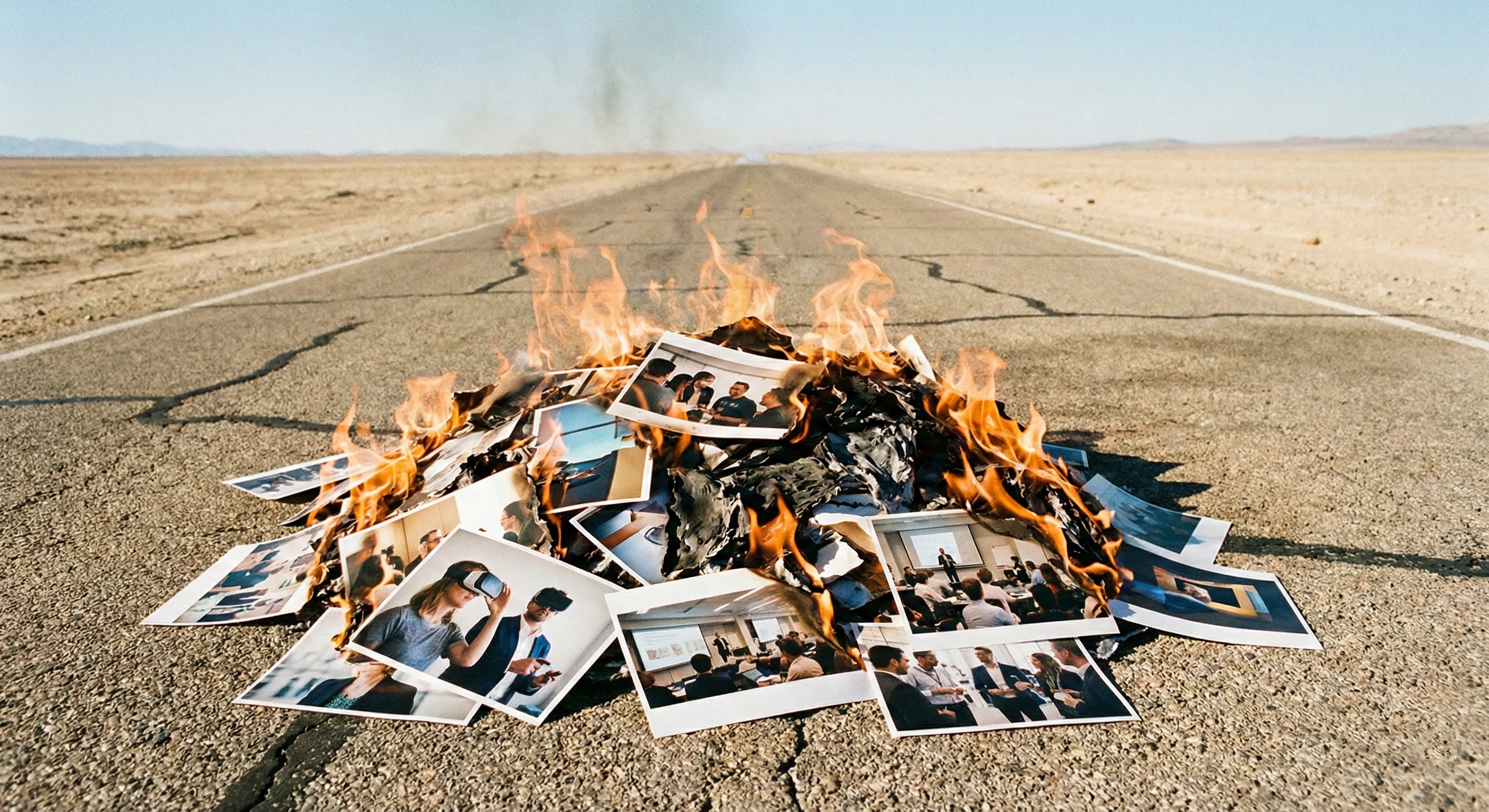
We’re burning it down and starting over.
The Great Leveling
I don’t produce events for fun. I produce events at inflection points—moments when the ground shifts so dramatically that people can’t navigate alone.
This is one of those moments.
In the last 18 months, something fundamental changed:
AI collapsed the barrier between “having an idea” and “building a product.”
82% of developers now use AI tools weekly. 41% of all code is AI-generated. The people who will build the most important spatial experiences of the next decade aren’t “XR professionals”—they’re domain experts with problems to solve, empowered by tools that didn’t exist two years ago.
At the same time, XR hardware finally became wearable. Not a gaming peripheral. Not a headset you strap on for 20 minutes. Glasses. Something you work in.
The AI × XR convergence isn’t coming. It’s here.
And the people navigating this shift need something the current conference landscape can’t provide:
- Clarity, not content.
- Capability, not inspiration.
- Real connection, not branded networking.
- Working sessions, not vendor theaters.
They need what we’re building.
1UP Summit: The Anti-Conference
Here’s what we’re doing differently—and why it matters:
1. Build Labs, Not Panels
A panel is performance. You sit. Experts talk. You listen. Maybe you ask a question. You leave with notes.
A Build Lab is work. You show up with your laptop. A platform engineer teaches you SDK patterns for 4 hours. You code. You debug. You ship something.
Panels deliver content. Build Labs deliver capability.
When you leave 1UP, you don’t have notes. You have working prototypes.
And for the platforms and sponsors? This is where the math changes completely.
Traditional sponsorship ROI looks like this: scan badges, export CSVs, hand them to sales, spend six weeks chasing cold follow-ups with people who barely remember your booth. It’s a grind that everyone hates and nobody talks about.
Build Lab ROI looks like this: your engineers spend four hours teaching developers how to build on your platform. Those developers leave with working code—your SDK patterns in their projects. They don’t need a follow-up call. They’re already building. The relationship isn’t “lead to nurture.” It’s momentum that compounds.
Forget follow-ups. This is building flow—and it grows.
2. Curated Connection, Not Random Collision
Traditional networking is a lottery. You wander. You hope. Maybe you meet someone useful. Probably you don’t.
xChanges starts before you arrive. Our team learns what you’re building, what problems you’re solving, who you need to meet. During the summit, those matches are arranged. The spaces are designed for depth—intimate rooms created by artists, not high-top tables designed for efficiency.
You show up. The right people are already there.
3. The 60% Rule
Most conferences optimize for insiders. The content assumes expertise. The networking favors people who already know everyone. Newcomers feel like outsiders.
We’re inverting this.
60% of 1UP Summit attendees will be at their first XR conference—not because they’re casual, but because AI empowered them to become builders. They’re serious. They’re ready. They just need a structure that doesn’t make them feel like they showed up to someone else’s reunion.
If you’re new to this, you’re not behind. You’re early. And we designed this for you.
4. No Booths. No Badge-Scanning. No Extraction.
Sponsors at 1UP don’t buy booth real estate. They buy the opportunity to teach.
Platform companies don’t set up displays—they run Build Labs where developers learn their tools by using them.
AI leaders don’t sponsor lounges—they mentor teams building real applications.
If you sponsor 1UP, you come to give, not to take.
This isn’t idealism. It’s strategy. The developers who build on your platform next year are the ones you teach this year—not the ones whose badges you scan.
The Lie We’re Refusing to Tell
Here’s what most events promise:
“World-class speakers. Unparalleled networking. The future of [industry].”
It’s meaningless. It’s not falsifiable. It sounds impressive and commits to nothing.
Here’s what we’re promising instead:
You will leave with more capability than you arrived with. Because you are in a qualified room with peer-driven learning - you’ll have more opportunities for meaningful connections - what you do with them is up to you!
That’s it. No theater. No hype. Just a specific, measurable claim we’re designing every hour of the summit to deliver.
If we fail, you’ll know.
Who This Is For
1UP Summit is for builders at the AI × XR convergence.
If you’re an AI developer realizing spatial computing is the next frontier—this is your entry point.
If you’re an XR veteran wondering how AI changes your craft—this is where you find out.
If you’re a domain expert who just discovered you can build things—this is where you learn what’s possible. If you’ve been waiting for the tech to get easy enough—your wait is over. You’re the guest of honor.
If you’re a platform company wondering how to reach the next wave of creators who don’t yet call themselves “XR developers”—this is where they’ll be.
If you’ve been to ten conferences this year and left every one exhausted and empty—this is the one that’s different.
August 2026. San Diego.
1UP Summit: August 18–22, 2026
UC San Diego Park & Market
2,000 practitioners in person. 5,000 more in the global hackathon.
We’re not selling you on “the future of networking” or a “world-class experience.”
We’re offering you a room full of people doing real work, a format designed for genuine transformation, and a promise:
You will leave capable of things you weren’t capable of when you arrived.
That’s the whole pitch.
Anne-Marie Enns and I built the XR conference industry. We watched it become what we designed it not to be.
Now we’re building what comes next.
The World’s Premiere AI × XR Summit. The Fastest-Growing Event for Builders at the Convergence.
Join us.
Cameron Kootz
Co-Founder & Curator, 1UP Summit
Anne-Marie Enns
Co-Founder & Curator, 1UP Summit
1upsummit.com
Speaker Applications: 1upsummit.com/speakers
Partnership Inquiries: 1upsummit.com/sponsors
We built the category. Now we’re building what it should have become.