
The Spatial Layer Your Phone Can't See
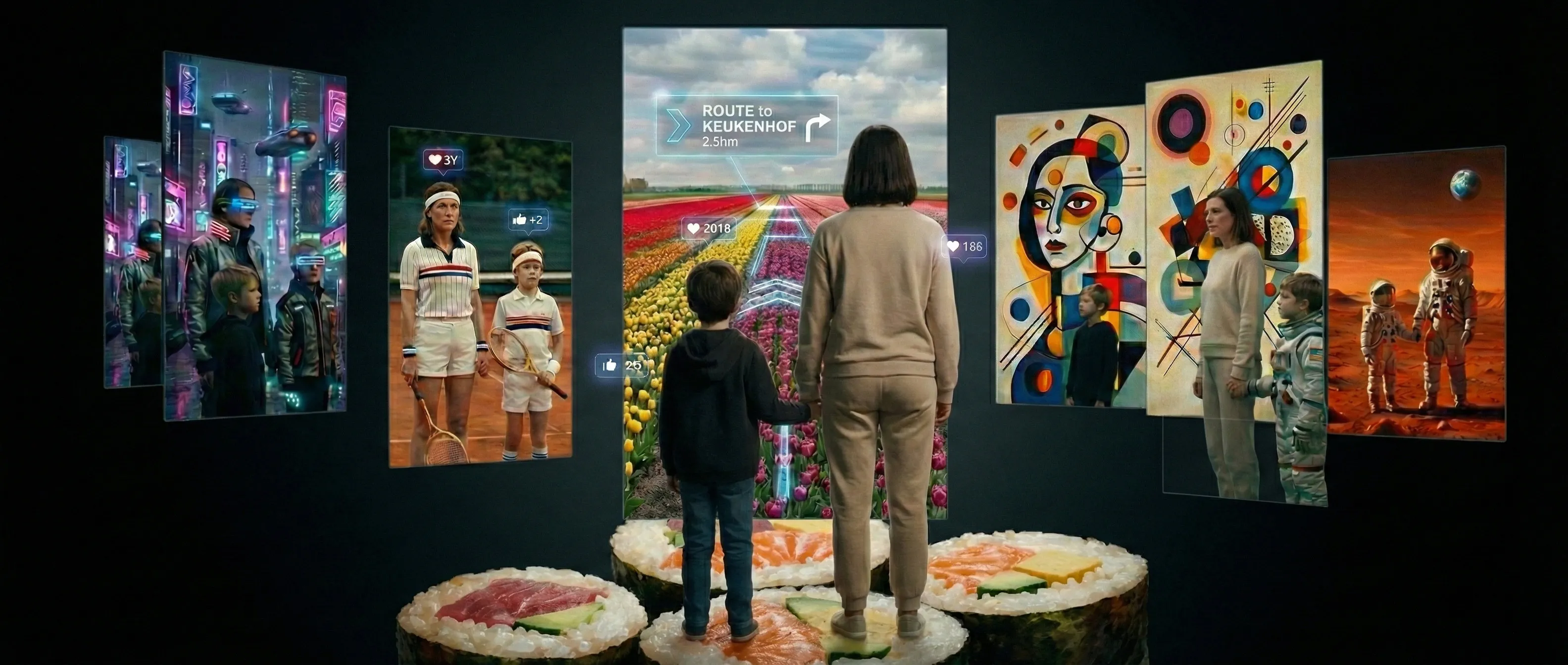
Someone is about to build the most valuable company of the next decade.
It won’t look like Google. It won’t feel like ChatGPT. But it will do exactly what they did: give people a new way to see.
Google gave us a way to see the web. ChatGPT gave us a way to see AI. The next company will give us a way to see physical reality itself—live, indexed, interactive, floating in front of our eyes.
That company doesn’t exist yet.
Or maybe it does, and we just can’t see it.
The Pattern
Picture 1998.
A man sits at a beige computer, manually cataloguing websites. His job is to read pages and organize links so other people can find them. Thousands of people do this work. The internet is a library with no card catalogue, and humans are building one by hand.
Then two Stanford grad students noticed something everyone missed: if you mapped the links between pages, you didn’t need those workers. The structure of the web itself could tell you which pages mattered.
Google didn’t invent the web. Google invented a new way of seeing what was already there.
ChatGPT did the same thing. AI had been running in the background for years—recommending your Netflix queue, flagging credit card fraud, autocompleting your emails. Nobody saw it. Then OpenAI put a chat window on a language model, and suddenly your grandmother had an opinion about artificial intelligence.
The technology exists. Then someone builds the interface that makes it visible. Then everything changes.
Google’s interface was a search bar. So simple it felt inevitable—but only after they built it.
ChatGPT’s interface was a conversation. 100 million users in two months. Fastest adoption in history.
Both understood something profound: the value isn’t in the technology. The value is in giving people a new way to see.
Now look at what just happened in hardware.
The Threshold
Smart glasses from Xreal, TCL, Asus, Rokid, and a dozen others crossed a line this year. 30-50 grams—the weight of sunglasses. Waveguides thin enough to look normal. Bright 4K displays. On-device AI that translates, captions, and guides without pulling out your phone.
Google just unveiled a three-tier strategy for Android XR glasses: audio-only frames designed with Warby Parker and Gentle Monster, monocular displays, and full mixed reality. Samsung’s Galaxy XR ships this year. The platform war for the space in front of your eyes has begun.
When glasses are heavy, XR is a parlour trick. When glasses are eyewear, XR is infrastructure.
For fifteen years, your relationship to information looked like this:
Look down at a rectangle. Interpret a map, a feed, a wall of text. Look up. Act.
We tolerated that because there was no alternative.
Spatial computing collapses that gap.
Raise your eyes and see which machines need maintenance. Which route through the airport minimizes delay. Which shelf has what you need, filtered by your budget. Which instructions matter for this task, this context, this worker—not a manual, but a tailored overlay.
The world becomes searchable in 3D.
And it becomes creatable in 3D.
Fei-Fei Li—the “godmother of AI” who built ImageNet and helped launch the deep learning revolution—just released Marble, a platform that generates explorable 3D worlds from a text prompt. Type a description, get a world you can walk through. She calls it “spatial intelligence” and says current AI systems are “wordsmiths in the dark—eloquent but inexperienced, knowledgeable but ungrounded.” They can talk about the world but don’t understand it.
Niantic—the company that built Pokémon GO—spun off its games for $3.5 billion and is now building what they call “a living model of the world that people and machines can talk to.” Their Large Geospatial Model is trained on 30 billion images. They just partnered with Hideo Kojima to create what he describes as “the real Death Stranding in the real world”—stories that unfold as you walk through actual cities, connecting with actual environments.
STYLY in Japan is building a “spatial layer platform” under the banner “Free Inner Creativity”—tools for artists and brands to place digital experiences in physical locations without QR codes or apps.
This isn’t just industrial. This is a new canvas.
Filmmakers will conjure entire worlds without the constraints of budget or geography. Architects will walk clients through buildings that don’t exist yet. Artists will paint on cities. Storytellers will scatter narratives across landscapes.
And here’s what should make every builder pay attention:
Whoever defines what appears in that layer—what is visible, highlighted, or quietly hidden—will shape how billions of people understand the world.
Google had that power over text. Uber had it over location. Spatial computing will have it over reality as experienced.
Right now, that power is unclaimed.
The Blindness
When Jensen Huang said “electricians and plumbers will thrive in the AI era,” he wasn’t wrong. Data centres need trades.
But the way it got memed—skip coding, learn plumbing—reveals broken thinking.
It assumes two buckets:
Bucket 1: Tech jobs. Screens. At risk.
Bucket 2: Simple jobs. Hands. Safe.
Reality is messier.
Routine cognitive work is exposed. So are manual tasks that robotics can handle.
The fastest-growing opportunities are in a third bucket nobody talks about:
Hybrid. Embodied. Tech-augmented.
XR-trained HVAC techs guided by live models. Field engineers whose glasses show sensor data as they walk a site. Facilitators of shared immersive spaces who can hold attention in 3D.
This isn’t “go back to the trades” or “stay in the office.” It’s the reorganization of work around spatial intelligence.
The World Economic Forum’s numbers: AI creates 170 million jobs, displaces 92 million by 2030. 44% of workers’ core skills disrupted in five years.
The winners figure out new ways for humans and machines to collaborate in physical environments.
The tools exist. The canvas is open. What gets built is up to the builders.
Your economic opportunity is directly proportional to how early you see this.
Three Eras of Seeing
SEO era (text web) Advantage went to those who understood how search engines saw pages.
GEO era (Generative Engine Optimization) Advantage went to those who understood how LLMs were trained and how generative engines synthesized information.
SPATIAL era (3D indexed world) Advantage goes to those who understand how systems see situations: who is where, doing what, with which tools—and what they should see next.
That last leap is hardest because it’s not just technical. It’s ethical:
What should a junior nurse see during a code blue?
What shouldn’t a gig worker see while cycling in traffic?
How much contextual commerce before it becomes predatory?
No algorithm answers those questions. They require designers, engineers, ethicists, and frontline workers deciding together what reality should look like through these lenses.
If You’re Not Blind
Three things follow.
1. Your real product is what people see.
The model matters. But in the spatial era, the interface is the ethics.
Where does information live—center of vision, periphery, or on tap?
What stays hidden to protect attention?
Whose interest does each overlay serve?
Those choices are your economic model. They determine trust.
2. Your moat is spatial literacy plus domain depth.
Everyone will have similar models and hardware.
What they won’t have: deep understanding of how work actually happens—how nurses move, how mechanics think, how teachers manage a room—and the ability to map that into spatial experiences.
If you can do that, you’re not “an XR dev.” You’re a spatial operator in a reorganizing economy.
3. Your edge is who you sit in rooms with.
Seeing the spatial layer is not a solo skill.
You need people building glasses and infrastructure. People dealing with AI labour transitions and regulation. People on the front lines whose eyes these overlays will live in.
That’s not LinkedIn content. That’s a room design problem.
High-trust. Small enough to talk honestly. Big enough to see patterns.
The Room
1UP Summit exists because there’s no obvious place where spatial operators, AI builders, and frontline practitioners sit down and ask:
“What do we want the world to look like when we open our eyes?”
Not in 2050. In the next product cycle.
The question isn’t whether the spatial layer will exist. The hardware crossed the threshold.
The question is: Who defines it? What economy does it create? Will the people building it be clear-eyed enough to do it well?
If you can already see this coming, your job is simple and difficult:
Don’t go blind. Don’t let memes stand in for strategy. And don’t build alone.